
Marshallese Interpreters and Translators: A Quick Guide
Updated: Feb 9
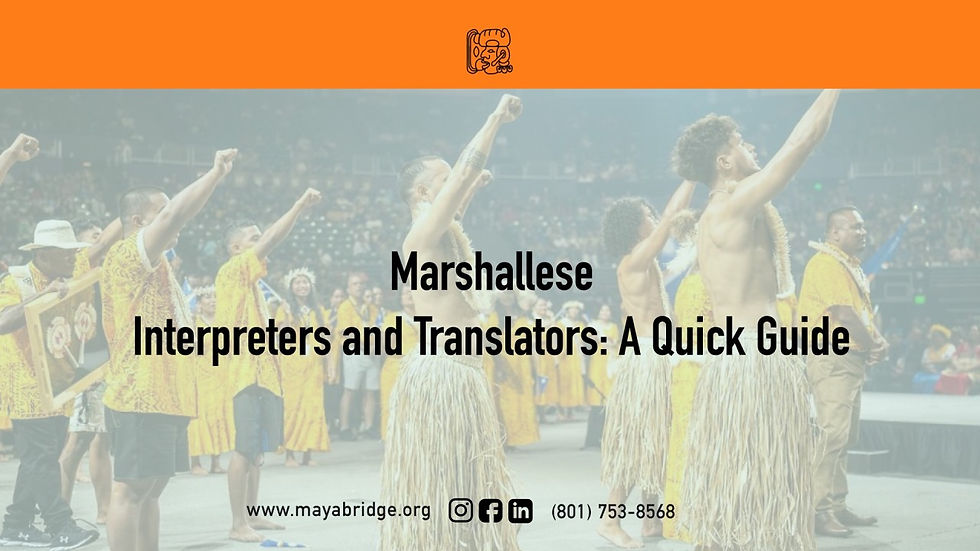
As the Marshallese people increasingly migrate to the United States for safety, economic opportunities, and a better quality of life, language access is one of their biggest obstacles. This is where Marshallese interpreters and translators step in and help migrants integrate safely into their new surroundings.
For the Marshallese, whose cultural and linguistic heritage has stood the test of time, language services play a major role in bridging the gap between their traditional ways of life and the challenges of modern migration.
This blog explores the Marshallese language, why the Marshallese are migrating, and the help interpreters can provide as they settle in the United States.
Who speaks Marshallese?

Marshallese is spoken in the Republic of the Marshall Islands, a nation of approximately 38,900 people in the central Pacific Ocean. It shares official status with English, but Marshallese is the primary language used in daily life, local trade, and cultural traditions.
Part of the Austronesian language family, Marshallese belongs to the Nuclear Micronesian subgroup of the Micronesian branch. It has two main variants: Ratak, spoken in the eastern island group, and Rālik, spoken in the western island group. Though some vocabulary and pronunciation differ between the two, speakers can generally understand one another.
Marshallese ancestry goes back thousands of years to Micronesian voyagers who settled the islands between two and four millennia ago. Skilled navigators, these communities excelled at open-ocean travel, using the stars and wave patterns as guides.
European contact began with Spanish explorers in the sixteenth century, though the islands were later named after British naval captain John Marshall in the late eighteenth century. Colonial rule, which later followed in phases under Spain, Germany, Japan, and the United States, reshaped Marshallese society as each power introduced its own language, religion, and government system. After World War II, the islands became a U.S. trust territory. They finally gained independence in 1986.
Maritime traditions are an important part of Marshallese culture. They once mapped long Pacific voyages with remarkable accuracy using stars, ocean swells, and stick charts. These skills, passed down through generations, continue to be a source of identity and pride. Community and connection are equally important in Marshallese society, as seen in the greeting yokwe, which can mean “hello,” “goodbye,” or “love.”
Why are the Marshallese migrating?
For decades, the Marshallese have migrated in search of better opportunities, especially for work and education. Under the Compact of Free Association (COFA), Marshallese citizens can live and work in the United States without a visa. Marshallese communities in the U.S. have grown rapidly in recent years, and families continue to build strong networks in places such as Hawaiʻi, Arkansas, and Washington State.
Climate change increasingly affects daily life throughout the Marshall Islands. Rising sea levels, coastal flooding, saltwater intrusion into freshwater, and prolonged droughts have made farming more difficult. While many families currently migrate primarily for educational opportunities, healthcare access, and employment, these mounting climate pressures could accelerate migration in the coming years.
Disruptive events, such as U.S. nuclear testing, have profoundly influenced Marshallese migration patterns. Between 1946 and 1958, the United States conducted 67 nuclear tests on the islands. These tests forced entire communities to leave their homes. Radiation from those tests caused long-term health problems whose effects continue to be felt today, including cancer and birth defects, as well as contaminated land and water. Families displaced during this period left for safer places to live and better access to medical care.

The Roles And Importance Of Marshallese Interpreters
Marshallese interpreters help migrants to express themselves and understand the information they are given, allowing them to better advocate for themselves and make more informed decisions.
Interpreters act as trusted guides for Marshallese migrants, guiding them through the complex U.S. immigration system, and helping them get access to medical, legal, and social services. In settings like doctor's appointments, immigration proceedings, and court hearings, qualified Marshallese interpreters are indispensable.
Besides providing language assistance, interpreters are also integral to intercultural communication. Having an interpreter who understands both American and Marshallese cultures can help make communication smoother and less stressful for both sides.
Professional Marshallese interpreters are in short supply, as demand exceeds availability. The language has relatively few speakers, with most living in the Marshall Islands or in diaspora communities.
Although many Marshallese migrate to the U.S., the majority work in agriculture, caregiving, or service industries rather than professional interpretation. Few receive formal training, and certification programs are limited. Consequently, hospitals, courts, and schools often rely on bilingual community members instead of trained interpreters.
This language disparity restricts Marshallese speakers' access to healthcare, legal aid, and social services. Without language services, they are at risk of misdiagnoses, unfair asylum decisions, and unjust deportations. Marshallese speakers need access to qualified interpreters to have a clear understanding of their circumstances and exercise their fundamental right to language access in the U.S.

Work With A Marshallese Interpreter from Maya Bridge
We offer language services for Marshallese and all of its variants. Our Marshallese-to-English interpretation services are trusted by government agencies, healthcare providers, and courts across the country. As a small, niche agency specializing in Indigenous languages, we are uniquely equipped to deliver on-demand Marshallese interpretation, 24 hours a day.
We offer:
Video Remote Marshallese Interpretation
Over-the-phone Marshallese Interpretation
In-person Marshallese Interpretation
Court-certified Marshallese Interpretation
Medical-certified Marshallese Interpretation
Marshallese Translation
Marshallese Voiceover and Subtitles
Learn more about our language services here.
Maya Bridge - A Leading Advocate For Indigenous and Lower-resource Language Access In The U.S.
At Maya Bridge Language Services, we’re a mission-driven interpretation agency offering 24/7 on-demand services. We proudly provide interpretation in over 230 languages, including more than 145 Indigenous and low-diffusion languages from Latin America, Africa, Asia, the Pacific Islands, and Native American communities.
Since 2021, we have worked diligently to mobilize, train, and evaluate a network of hundreds of interpreters both in the U.S. and throughout the world. Our growing network of trained interpreters ensures that Indigenous language speakers are heard and understood in critical moments, from healthcare to legal settings and access to government services.
Contact us to schedule a meeting or call us anytime, day or night, at (801) 753-8568.

About the Author
Jace Norton is a Q'eqchi' interpreter and linguist with an extensive background in the Q'eqchi' language. Norton lived and worked among the Q'eqchi' people from 2010-2012, created a language learning guide for Q'eqchi' in 2014, and worked in Q'eqchi' translation and interpretation from 2017-2021. In 2021, Norton founded Maya Bridge Language Services and is now a leading advocate for Mayan language access in the US.


Comments